Realism without the Tragedy?
2025 is the year we realized the world order is already changing. What is the theory of finding a new equilibrium for the world without another world war?

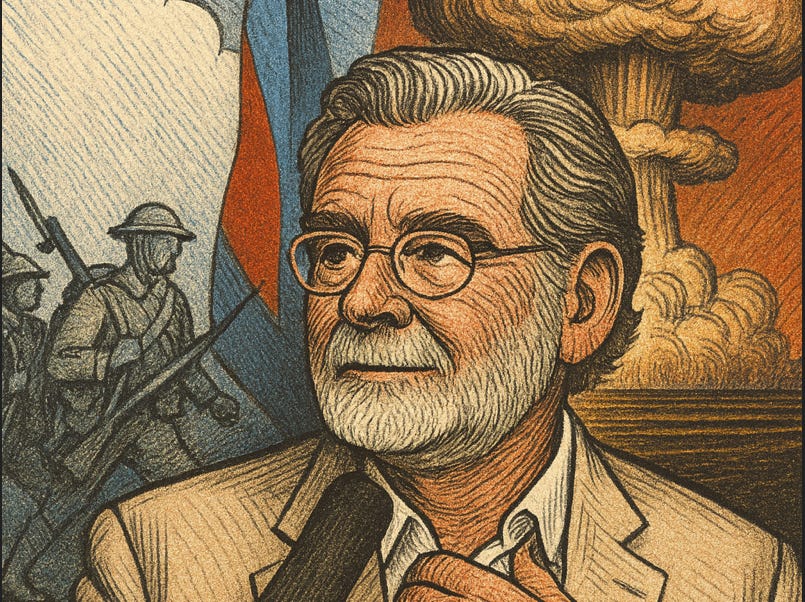
I spent four and a half hour today in the company of Australian strategist Huge White while rambling through the hill trails of Xindian, thanks to the marvel of modern technology.
If I can condense the experience (a podcast where he walks through 11 books that shaped his strategic thinking), I’d say it’s a more nuanced, humane and historically-grounded school of realism. More of a Jung to John Mearsheimer’s Freud. I got to the other side a more sophisticated thinker about geopolitics.
The cornerstone of White’s thinking is that the cause of war is the rise of a new order. This is naturally seen as wrong and bad because the world is perceived from the point of view of the existing order. But change is a natural part of life and sometimes it would be more wrong to deny change even as we acknowledge loss. And resistance or denial to the change is often the cause of catastrophic war. Mearsheimer would call it the Tragedy of Great Power Politics. White would say it’s not always just the rising power’s fault for being disruptive, but that existing great powers have a responsibility to accommodate rising powers into the existing order as well, and if it is not done, not even war can restore balance.
Below is my download of what I got from the pod (of course I recommend you listen to all of it if you have four and a half hours to spare.)
The Great War
While war has always been with us, technology has not. This often results in a failure of imagination in the decision makers on the ultimate costs of their actions.
When Germany rapidly rose in power in the run-up to World War I the other powers found that “disagreeable”. An alliance was set up to contain it. The advent of rail travel made it physically possible to shovel much more of the population to the battlefield. But the logistics takes weeks, making a contained, regional war impossible. If you don’t go all-in at the get-go you lose the optionality.
Each side believed that they would be able to deter the other with the show of force and cause their opponent’s alliances to crumble. In actuality, nobody was deterred once war started but fought to the last. It’s a deadly combination of sunk-cost fallacy and pride.
The more things change…
Technology extends the scope of all human endeavors, including war. But the cause of war remains the same. According to Thucydides, there are just three: fear, interest and honor. People often indulge in folk cynicism and proclaim economics to be the ultimate cause of war. The world would be simpler and safer if this were the case. Very, very often, honor is stronger. Honor is how good we feel about ourselves. Sometimes, it’s just a desire not lose status.
Versailles called for massive reparations from the German state. But it also left the German state to the Germans. This weakened and resentful German state ultimately still hasn’t solved the problem of where it belonged in the world order. Conditions were perfect for Hitlers rise.
Chamberlain et al, were not just guilty of appeasement, they were vague about where their actual red line was. Hitler was reportedly surprised when the British declared war over a lesser casus belli, the invasion of Poland. It is possible if the rest of Europe had been clearer about that red line, he would have been deterred.
A combination of appeasement and deterrence is essential to maintain peace. The allies drew a line down the middle of Europe and told the Soviets “this far and no further.” This was both appeasement, and deterrence as backed up by US garrisons and nuclear arms. The line was clear. For the entirety of the Cold War direct confrontation was avoided because of that clear line.
The Importance of an Inclusive Order
Post war, the Japanese and German states were re-made by the victors. This worked for the winners because both were effectively neutered, but it also worked for the losers as at last a place have been found for them in the world order.
“This is a story without heros…and without villains,” said White. It’s all too easy to blame a Hitler without seeing the structural forces that pushes them into power. There’s also what I call “Evil Inflation.” Putin is rounded up to Hitler. Xi, if not quite rounded up to Hitler, is also supposed to be a terrible expansionist dictator.
A new generation seems to have grown up without the imagination to fully realize the possible consequences of modern war and caught in Harry Potter Thinking. This might result in the annihilation of the human race after all or at least a severe setback since all the infrastructure of substantial nuclear exchange remain intact, but nobody believes they will ever be used any longer.
Russia: Out of the Order
After I listened to the whole podcast I felt like I got a whole download that really helped me organize my thoughts about this very loaded moment we are all living through. Huge White is most controversial for his conclusion that the west, and especially Australia, should make it clear that it will not interfere with China over Taiwan. But my mind instantly went to the implication of his arguments to the war in Ukraine.
During the Cold War, the Soviet Union famously collapsed under the weight of its own contradictions after a half-century of patient containment. But its successor state, Russia, was not able to be incorporated into the existing world order in the aftermath of the USSR’s fall. As we have seen from the example of Germany’s resurgence after World War I, a great power being left out of order will cause conflict to rise again.
In my mind, a great flaw of the “Rule-based International Order” based on Liberal Democracy as an Operating System is that it’s not compatible with great states that don’t share the same OS. Smaller ally states that are fully compliant like Saudi Arabia can do whatever they want domestically. But Russia was too big to be different. But also too big to be left to its own devices.
As the writing is on the wall for Ukraine, a great worry is that Russia will be left more out-of-order than ever. This means even after the war is over, the next conflict between Russia and the west will only be a matter of time.
Some Russian commentators thinks this is why Russia needs to seize more of Ukraine, to create more buffer. But this doesn’t really address the issue. The only thing that will address the issue is the transition to a different world order, one that can accommodate different systems of governance while remaining stable.
Lack of imagination is dangerous
It’s easy to see how the European leaders sleepwalked into WWI and judge them for how foolish they were. But world leaders today have not gotten any wiser. The Cold War generation, for all their flaws, had a healthy fear of the bomb and that kept them in line. But a new generation seem to have grown up without that respect and the idea of proliferating nuclear weapons to “friendly” countries like Japan and Poland have become popular in some niches. Or else the use of “tactical” or “baby” nukes to gain a decisive advantage without triggering Mutually Assured Destruction.
It’s important to use our imaginations for the downsides because we can no longer to be schooled by another World War.
I almost feel kind of silly and hyperbolic just typing this. Kind of uncool. Like, who’s still afraid of actual nuclear war? Everybody Knows nukes actually keep us safer as a deterrent.
It’ll not just be a sad but an undeserved ending for humanity (or a big swathe of it) if we fell due to such midwit thinking.
“We’ve had a 35 year holiday from nuclear weapons…well they’re back,” said White, “there absolutely no reason to expect a war between the United States and China over Taiwan not to become a nuclear war.”
By the way what happened to Australia?
They used to be a serious country with ambitious and thoughtful people like Huge White and Paul Keating. But now…total clown show.
According to an Aussie friend of mine, they’ve fallen to “Larrikanism”. I don’t know what all that’s about. But AUKUS was “Getting Ripped Off by America level: Taiwan.”
Full interview with Hugh here on Substack: https://open.substack.com/pub/joewalker/p/why-great-powers-sleepwalk-to-war
Hugh White really is a great realistic take, argues in good faith, very well researched, willing to argue both sides, etc.
This video is basically Australian defense policy:
“So under this scenario we’re spending close to 30 billion dollars a year to protect our trade with China from China?”
https://youtu.be/sgspkxfkS4k?si=KhTl4YmVxoAngYSj