Welcome to the Involution
Have you heard? Things have gotten so bad in China, Xi is going on an “anti-involution” campaign. But what does “involution” mean exactly again?

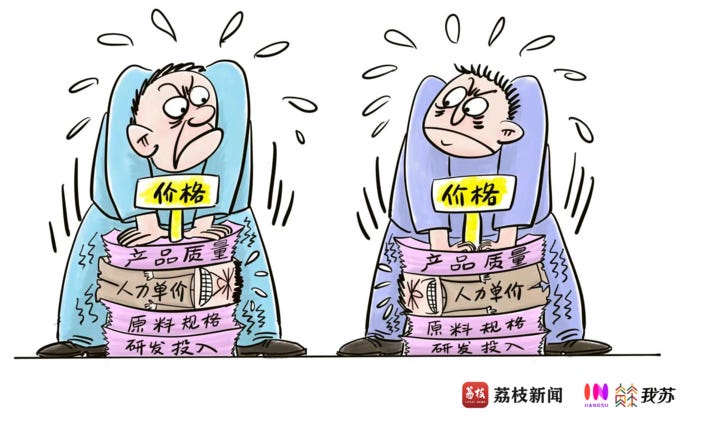
For 8-15 years everything works beautifully. Costs plummet and even junior Chinese executives get to fly business class because everyone is so flush. Then, on a cursed day, some Chinese guy figures out how to do it without the Germans.
The $8,000 widget becomes $950 overnight.
If you asked him how he arrived at that insane pricing he’ll say “I take my cost. I add my 20% profit. Boom.” But wait! You and the woebegone German are the only people on the planet with this technology? Why not price it at $6000? You’ll make more money because you still significantly undercut the German. You’ll both survive and have more money in your pockets! It’s a duopoly.
Nope! That maniac, even after he buried that Mittelstand that has been passed through multiple generations minting fat profits, will keep cutting costs. Junior executives aren’t flying business no more. And then he’ll lower prices. On himself.
It’s pathological. I’ve heard Chinese economists beg businesses not to do it. But this hyper-competitive behavior has gotten so bad the Chinese government is cracking down on it. They call it: Involution.
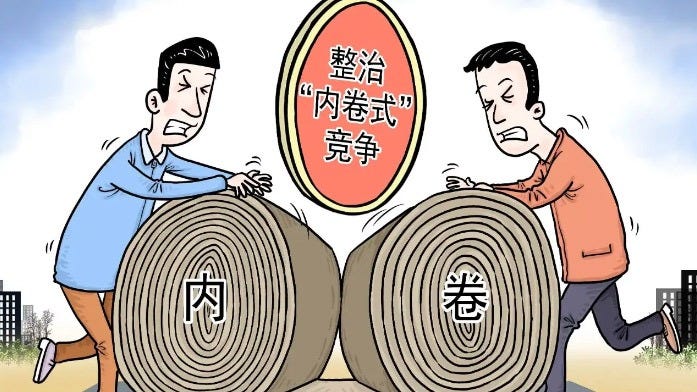
The Toyota Way on Steroids
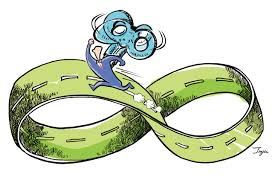
The best metaphor I’ve heard to explain involution, or “內卷 neijuan” comes from Shanghai-based energy analyst David Fishman. Imagine a snake eating its own tail. The first third goes down easy, but as the snake coils up tightly upon itself, each additional bite becomes more painful without obtaining much progress to show for the effort. But it can always go just a little bit further:
It's impossible to truly swallow yourself, but to survive you have to swallow more than the other snakes. That's 卷.
Involution does not mean oversupply...
Involution does not mean excess capacity...
Involution does not mean production subsidies...
Involution does not mean manufacturing expansion...
Involution is the state of extreme competition and its downstream effects
I would add that there’s a self-directed nature to involution that makes it especially exhausting and differentiates it from simple cut-throat competition which can be found just about anywhere with markets.
Go back to that psycho who lowered the price on himself. Why would he do that? Because he knows that if HE figured out how to make the widget from the German guy, somebody is going to figure out eventually how to undercut him.
It reminds me of when people used to talk up Kaizen and the Toyota Way. But while the Japanese mindset of constant improvement sounds kind of zen and aspirational, I don’t think we’ll see any airport books about “Neijuan: The Chinese way of eternal competition and not returning profit to shareholders.”
Just like in Econ 101
After all these years ago learning about how perfectly competitive markets drive profit margins down to nothing and that’s why socialism is bad and communism is evil and markets can never be interfered, I finally found something like a it in China’s involuted markets.
There’s a lot of confusion that Chinese companies can be involuted because they are subsidized by the government. It’s actually not true. The way China does industrial policy is intensely Darwinian, a point that is often missed by western commentators who tend to pass judgements on Chinese subsidies as “cheating” even if they are lower than western subsidies.
Imagine an endless battle to the death with freshly spawned entrants to the arena as soon as one gladiator falls over. The Chinese government might pay some money to get the first gladiators spawned in each widget arena, but after that they are self-spawned by entrepreneurs.
This has led to some interesting realignments. Communists and Chinaboos are all of a sudden super devoted to completely ruthless open markets. They see any kind of a moat as an excuse for rent seeking.
Meanwhile, anti-China western guys criticize these perfectly competitive markets just like we learned as the ideal in Econ 101 as too brutal and laissez-faire. Barbaric! After all, it’s true you’d never find “involution” in the west. Cut throat competition yes, but the goal is to be the last guy standing. In China the competition is so intense you cost down against yourself lest your fat margin attracts a competitor.
Seems like “China is communist” is just a meme now. So perfect competition has gone from being neoliberal-coded to being communism-coded. Now that the seeseepee tamed the market to their purpose, commies see it as the perfect torture chamber to pit capitalists against each other while spawning cheap consumer goods for all and creating aura for their ideology while economists rend their garments about “oversupply” and “worsening profitability.”
No “One Slice Solutions”
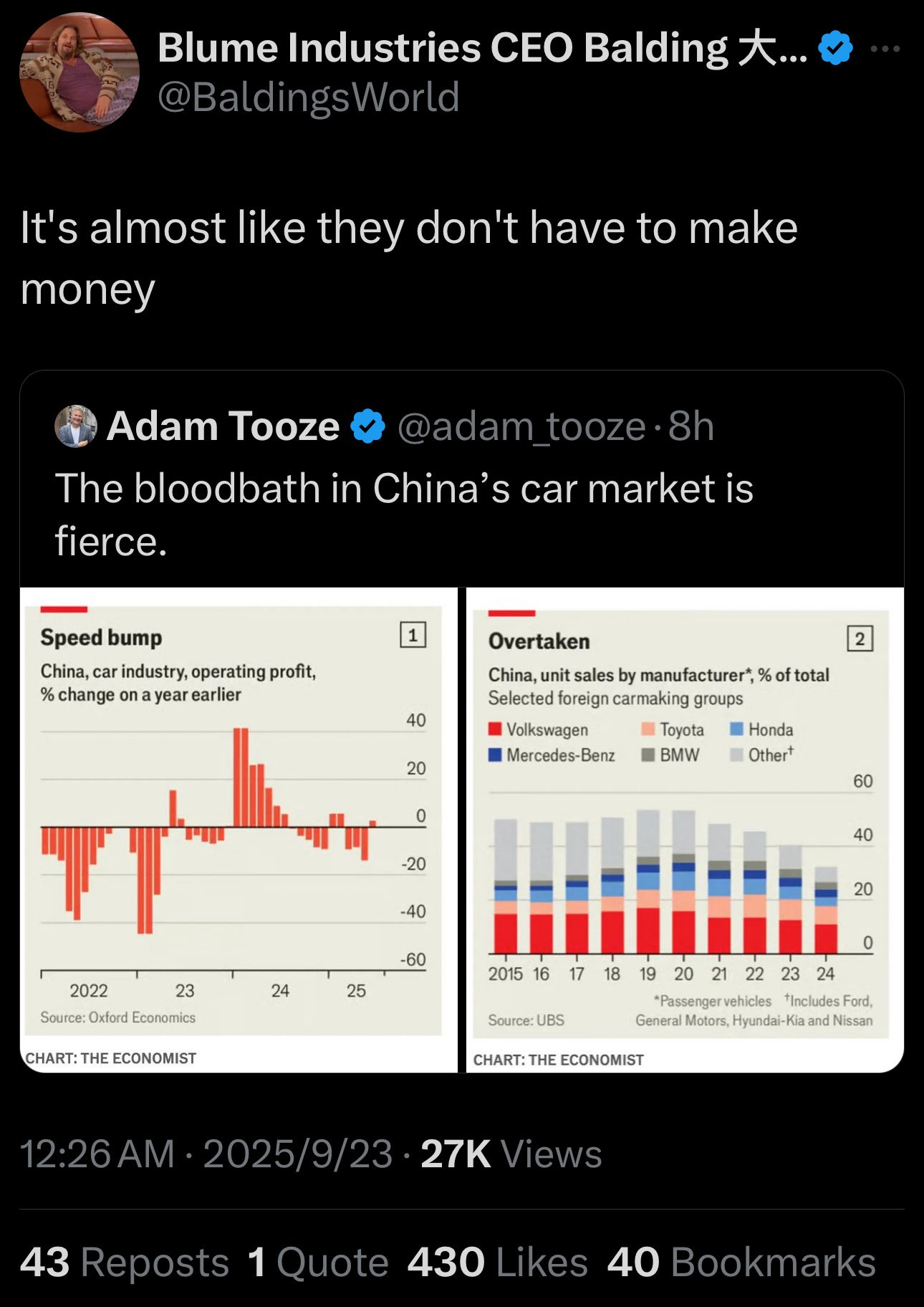
Like so many things in life, China’s intensely involuted competition is a double-edged sword. On the one hand, it’s hard to argue with results. On the other hand, there’s a sense that everybody’s getting burnt out and nobody’s making any money.
There are some sectors that are more involuted than others. Electric Vehicles are terrible, with every po-dunk province thinking they need their own me-too brand. However, other sectors like batteries are harder to copy-paste with their unique cutting-edge chemistries. And so Chinese National Champion CATL have a healthier natural moat and less insta-competition.
After making the cryptic and somewhat passive-aggressive statements like “not every province need to rush into AI and EVs,” Xi has been more frankly critical of involuted competition, describing it as “chaotic” and calling for an “orderly exit” of outdated production capacity.
However, this does not mean the hammer is being dropped on a particular sector or another.
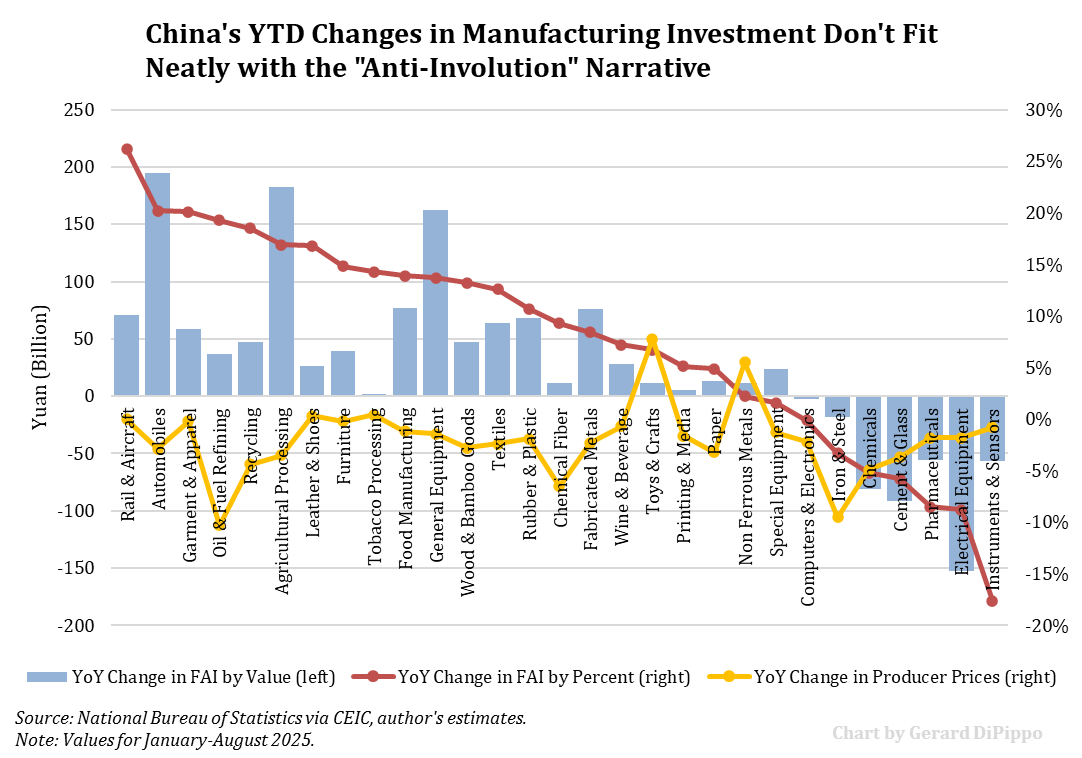
Indeed. Since we are learning new terms in Chinese, here’s another one: The One-slice solution (一刀切). This is generally something disparaging said about a policy measure that’s one-size-fits-all rather than sensitive to complicating factors. There’s much talk about the need to avoid a one-slice solution as China finesses its way out of involuted competition.
Because it’s not just the businesses that are involuted, but the people. In the wake of COVID and the somewhat-controlled demolition of the Chinese housing bubble, nobody is feeling flush anymore and everybody feels involuted. Those with jobs, working too hard, while many youths are anxious and unemployed.
And involuted consumers don’t spend. They might even end up lying flat!
Frankly there is nothing unique about market competition in China, only that it has been given its own term and perhaps that it is more intense. AWS for many years lowered costs voluntarily even though it was the clear leader in cloud services.
This is a great article and super-interesting!! One thing I didn't understand is how the new entrants get capitalized if the expected RoI is essentially running to zero. Usually there is a concept of "required return" (otherwise investors might as well just keep their money under their mattress) that prevents the cost of capital from going negative.