
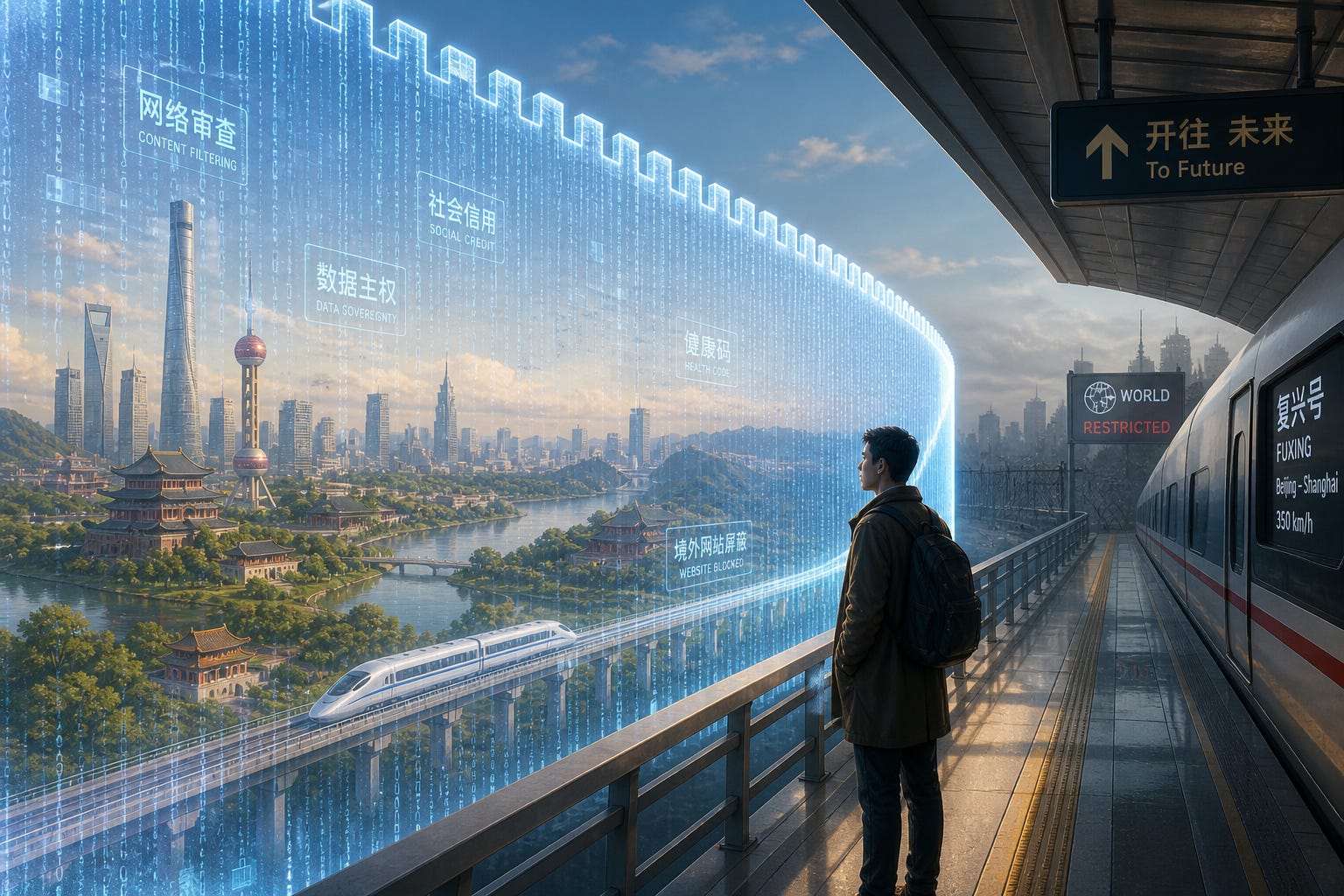
When I was wrapping up my recent China trip in Beijing, I met up with someone who identified as a Chinese liberal for coffee.
« Am I proud of China’s accomplishments? It’s complicated. It didn’t used to be that People’s daily and CCTV were mouthpieces and Xi Jinping’s blog. That’s what they are now. Speech has become so compressed, it’s suffocating. »
For people that we can broadly called « Chinese liberals » the past ten years have been a terrible disaster. They are not just oppressed by the state, they’re harangued by their fellow Chinese for being syncophantic to the west and unpatriotic, and they also can’t deny that China undeniably glowed up in the time they insisted the government was going the wrong way: it is now stronger, more powerful and better able to stand up to a rogue United States.
« There is a dark side to the narrative of national rejuvenation, » he said, « it is narcissistic and isolating. I am not unpatriotic. I have a vision of China that is more expansive and globally connected. China does not need to be a fortress. »
Even though I too wish for a China that’s more open and transparent one day, at some point I stopped being able to connect with what this person was saying. It’s 2026. China just fended off Trump’s Tariff attack last year. And all the chaotic energy war Trump started this year we know have the underlying logic of trying to starve China for energy and food.
Say what you want of Xi Jinping’s paranoia…sometimes only the paranoid survive. At this point in time particularly, it’s very hard for me to say…right. China’s problem right now is that it’s not open enough to criticism.
Waiting for the tipping point
My friend is not the only Chinese liberal. Others not only think the same but have been so immiserated that they’ve “run” away from China. The Xi-era peak for “runnology” probably happened as the pressure of the COVID drama built to a climax. Unlike the earlier waves of Chinese migrants who were attracted by the alluring pull of life in a first-world country like the United States while Chinese quality of life remained low even in big cities, the “runners” were pushed by what they percieve to be increasingly suffocating lack of freedom. In many cases, their quality of life took a big hit as they quit fancy Shanghai jobs to go to unglamorous and contingent situations in Europe, Thailand, and most of all Japan.
The X account known as “Teacher Li” is not technically a runner. He was an art student who now can’t return to China because he became a dissident during the COVID years and his social media is a hub for all the bad news in China the government wouldn’t want you to know. But I think of him as being spiritually inextricably entangled with the “runnology” phenomenon. The FT recently did a big profile on him:
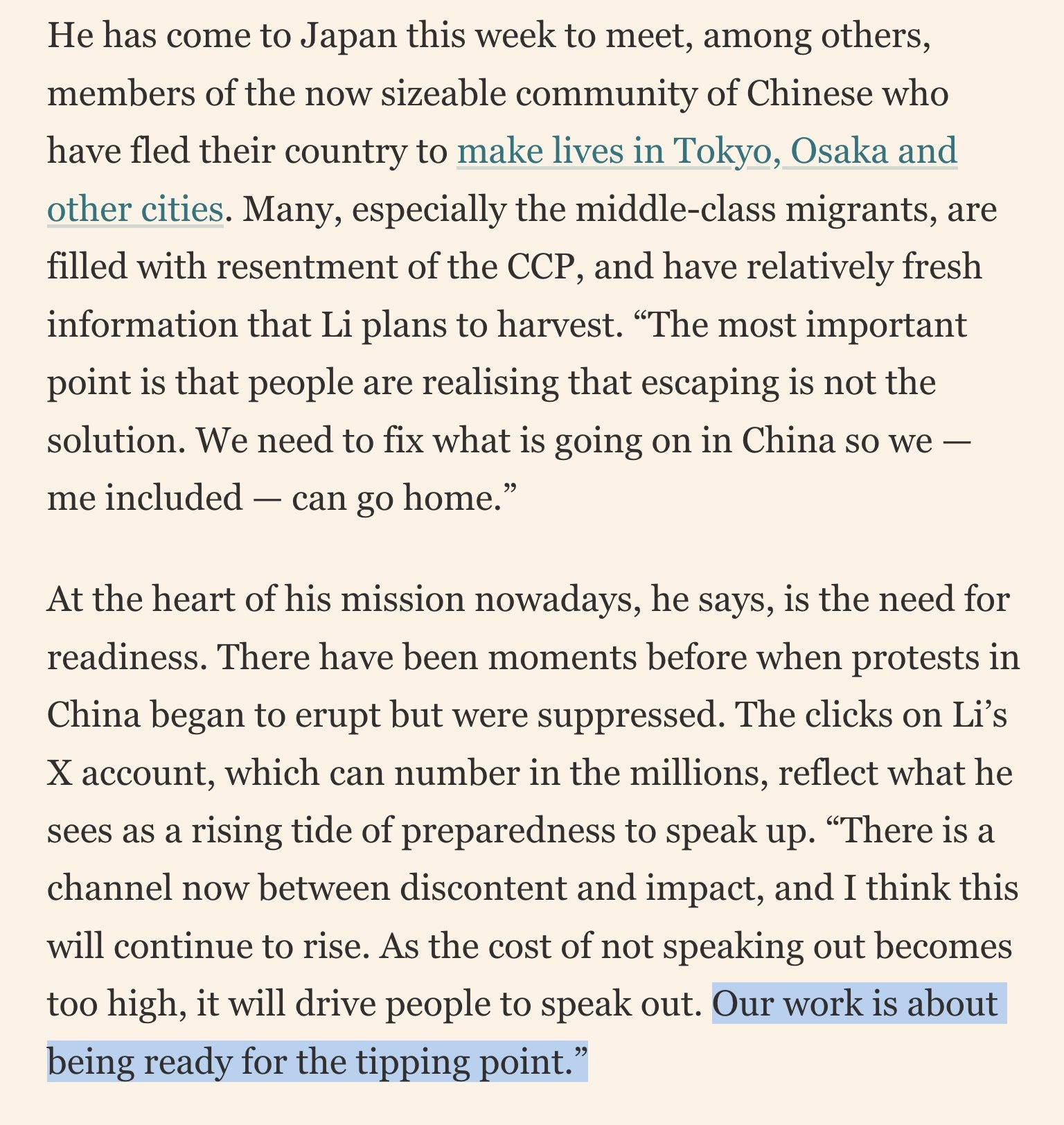
Li says “We need to fix what is going on in China so that we — me included — can go home…Our work is about being ready for the tipping point.” The tipping point presumably means The Coming Collapse of China. But if history is any guide, Li and his fellow dissidents might be waiting for a long time.
The Dissident who Changed His Mind
Instead of Teacher Li, I wish the FT did a profile instead of Xiahe, also known as “A Gay named Summer” on his Youtube Channel.
Just about a year ago, Xiahe was my favorite Chinese dissident. I was already more pro-China by then, but really fascinated with the “runners” and the dissident scene. To me, it was fascinating that these people would run AWAY from China just as it aura’d up. It must be like the opposite of getting the last helicoptor out of ‘nam.
I would spend hours watching videos of various “runners” as they start their new, crappy lives. There was a girl name “Hydemax,” a young woman who impulsively bought a fixer-upper in Hokkaido. She found life a lot more treacherous than she expected, although still rewarding in its own way. She’s obviously less resourced. And her content is a lot more about Overcoming. The house in Hokkaido might have been just Y700K, (less than $5000USD), but that house is actually an endless sinkhole for blood, sweat, tears and yes, more money. She’s incredibly real as the shares about how much she dislikes Japanese food as she has her supermarket dinner in front of the TV washed down with alcopop. But then she ate a Hokkaido strawberry she grew all by herself on her own property and maybe it’s all worth it after all?
You can see the golden lustre of the west built up through the decades fading with each generation. There are now videos titled “Do NOT run to Australia! Australians are running FROM Australia.”
But yes, Xiahe was my favorite because he was exceptionally cogent and he gave very blistering but historically grounded critiques of the Chinese government that I enjoyed even though I disagreed. And then one day…all I can say is he broke. I was surprised that he had a video where he said positive things about China’s development. Then another. Eventually, he came out with a video called: “how I went from being a dissident to being a seeseepee propagandist” and in his trademark devastating style, he said simply…"it’s 2025. It’s not I who changed, but the world who no longer entertains failures. When all the anti-seeseepee dissidents have seen their narratives gone bankrupt, those who remain anti-seeseepee can only be anti-reality.”
I don’t suppose it fits with the FT’s narrative or interests to interview a Xiahe…or even a Hydemax. They have a narrative to push.
Xiahe is still in Japan…now a “dissident” making pro-China content. The irony is thick, but hey. I feel like he stayed true to himself.
There are “liberal dissidents” everywhere, including in my own country. (I used to be one myself.) But two issues with being a “liberal dissident”: (1) first, the liberal dissident is focussed on a narrow set of “political liberties” and basically ignores all other aspects of human freedoms including freedom from poverty, illiteracy, poor health and gender/social inequalities. It’s indefensible to prioritise such a narrow set of priorities; liberties are important for sure, but they are not all that matters.
(2) second, the “dissident liberal” tends to be a cosmopolitan. He/she has no local loyalties. Many dissidents (think of the Iranian dissidents in the US) even go to the extent of calling for the destruction of their societies. Without local loyalties, it is almost impossible to engage in collective action and social choice. Everything is ultimately individual choice and individual goals. That is a very narrow understanding of what matters. There is no issue with having individual goals, but they are not all that matter. Wr also care about equality, fairness and extinguishing poverty in our societies.
I have ceased being a “liberal dissident” long ago. In fact, I think many “liberal dissidents” turn out to be tools manipulated by especially illiberal and despotic regimes (like the CIA).
I'm on the same page as you w/r/t the mixed feelings of sympathy for Chinese dissidents (it's a normal and good thing to be frustrated with your country and to want it to be better) with confusion at people whose seeming reaction to improving infrastructure, technology and general standards of living in their country is seething rage.
If I had to try and understand where they're coming from, I'd say that our beliefs and responses to events are not only a function of the facts themselves, but the salience we assign them through our mental model of how the world works, which largely reflects our values and is influenced by culture, formative experiences etc.
So for these dissidents, I would assume that in their mental model (based on our early experiences and generational influences that make them strongly supportive of Anglo American liberal values), the most salient data point in whether one's country is or isn't successful is how closely it matches ideals of individual liberty inspired by classical liberalism. To give them their due credit, it's largely true that China has not advanced much in matching this ideal in recent years, and in fact has retreated in some areas, largely because the Chinese government isn't particularly committed to this ideal, and also because the cultural values of the broader Chinese population (as reflected in data such as the World Values Survey) tend to prioritise other factors such as security over individual liberty.
From this pespective, what's happening when these dissidents' say "meh" to high speed rail, robots, poverty alleviation etc. is that their mental models' don't rank this evidence as being as much of a sign of success as say, someone who prioritises economic growth and security over civil liberties.
That's my best guess anyway. I would also say that those who are able to change their beliefs likely do so because in their unspoken mental models, development and economic wellbeing rank as a more important value than those who remain committed to their dissident status.