Does China need the foreign press?
As the world Chinamaxxes, reporters are out and influencers are in. In the long run, is this good or bad for China?

China recently denied New York Times reporter Vivian Wang a new journalism visa. That’s a sign of Xi Jinping’s insecurity, said Nicholas Kristoff:
The Times, which has covered China since the 1850s and once had about a dozen correspondents in China, now has just one -- because of visa restrictions. China is a major international power, but it displays a remarkable lack of self-confidence when it bars correspondents like this. It will still be covered but from places like Taiwan in ways that can't do it justice. China has some extraordinary accomplishments in science, in education, in health, in infrastructure; a baby born in Beijing today has a longer life expectancy than a baby born in Washington DC. Yet China fears international coverage in a way that I think reflects a political immaturity and hurts itself. 搬起石头砸自己的脚.
搬起石头砸自己的脚, by the way, means to “pick up a rock only to drop it on your own foot.” Kristoff is saying that kicking out reporters is a counterproductive way for China to manage its own image. But the problem is, in the aggregate the international perception of China only improved as they kicked the western journalists out.
Instead, China opened its doors to tourists who came an saw the country for themselves Visa Free. All of a sudden the world got China-fever.
An Imperfect Lens
I had an interesting back and forth with Kaiser Y Kuo about this yesterday. For Kaiser, there are too many pro-China commentators taking the “don’t let the door hit you on the way out” attitude to the foreign press. “When it's combined with this ethnonationalist expectation that, as someone of Chinese descent, she should be more "favorable" or less critical in her coverage, and with a detectable misogyny that's altogether too common when the "villain" is a woman, it's a terrible look and reflects badly on Beijing, as does this expulsion.”
The thing is, I’ve been a reporter. And my value as a reporter has always been to get “the story.” I feel like if we only read the respectable foreign press on China, we would have missed “the story” time and again. The western press have given us cliche after cliche while consistently missing the mark.
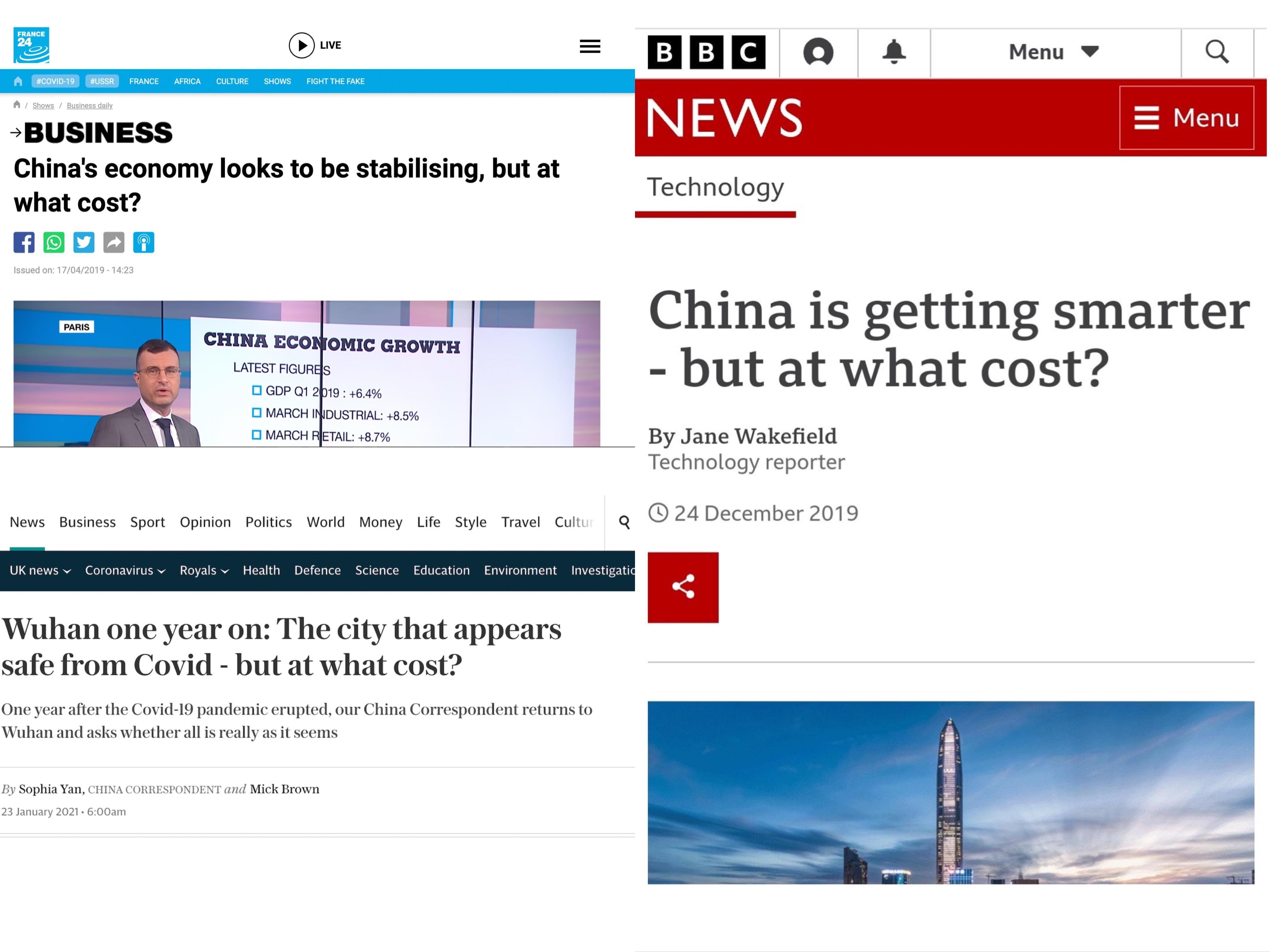
Instead of learning about China’s transformative infrastructure buildout, we got stories about ghost cities. Instead of contexualizing belt-and-road projects as an initiative rewiring our world, we got stories about bridges to nowhere and debt traps. Instead of covering the Chinese revolution in mobile payments, we got stories about social credit score and AI surveillance. Even when Chinese progress is undeniable, the vaguely ominous question “…but at what cost?” is tacked on at the end.
Regardless of the rights and wrongs of China throwing reporters out, I think the foreign press needs to take some responsibility for how they let their readers down. They need to take a look in the mirror and realize that they missed the Big Story and it wasn’t the Chinese government’s fault.
“No doubt there are huge holes and a lot of biases, structural and otherwise. But a great many would be addressed better by having WAY more reporters, not fewer,” argued Kaiser. Maybe he’s right. I really don’t know.
Press freedom wasted
I’m not a big fan of how the Chinese handles the press, either internally or with regards to foreign correspondents. However, I agree with George Yeo that the Western press has done everybody a disservice:
The Western world has been so used to being dominant and of patronizing the non-western world that when China made rapid strides, they found it psychologically difficult to accept. And there was an informational campaign to diminish China. The trouble is when you do that you deceive your own people. And for far too long there was an underestimation of China.
…and suddenly when the statistics break through the information war people got angry.
The ironic thing is, despite the fact that China felt burnt by foreign coverage, they are actually in the process of trying to get more reporters in again. Right now the strategy seems to be being a lot free-r with temporary reporting visas. At least, that’s what I heard from a freelance reporter passing through Taipei. The problem is, there’s a lot of good stuff happening in China now that they would like international press coverage on. No amount of tiktok-famous influencers can quite replace the recognition of a positive story in the New York Times or Wall Street Journal.
I’ll let Mattias Müller, who used to work in China as a correspondent, have the last word:
1. I am firmly opposed to the expulsion of journalists. However, the full picture is that during Trump’s first term, America also expelled Chinese journalists in droves.
2. Regarding my personal experiences as a correspondent in mainland China: the Chinese no longer trust the correspondents, and the correspondents no longer trust the Chinese. However, the latter bear a large share of the blame for this.
3. Two anecdotes: I was looking for a Chinese expert on North Korea. The one who was perfectly suited to my needs no longer spoke to correspondents. Why? The NYT had put words in his mouth that he hadn’t said in an interview.
4. One of the world’s leading facial recognition companies was open to correspondents; I had a great appointment there. At some point, the company stopped receiving correspondents because a German TV channel had turned the entire appointment into a human rights issue.
5. I oppose the expulsion of correspondents. But Western media have often degenerated into mere propaganda machines. This is also the result of transatlantic sycophants in the headquarters. Any correspondent who doesn’t bash China has lost.
Those headline screenshots gave me a good laugh. It does appear that as you mentioned the US media has basically repeatedly shown its inability to properly report news factually, and that each reporter in China is basically a net negative even for actually getting facts out.
The COVID headlines made me remember, in Taiwan everyone was being told to constantly scan QR codes for the exact same COVID contact tracing (OK It was called 實聯制 instead of 實名制 and it used SMS instead), at first people could quarantine at home but later people had to stay in quarantine hotels for 14 days and be monitored, yet it turned into Taiwan's democratic virus miracle vs China's authoritarian unscientific surveillance.
Like you mentioned, many of the most important stories like the rise of EVs, clean energy industry and solar plus nuclear, domestic AI industry and social media platforms, management of COVID, all get put into "at what cost" reporting. since this reporting visa is ultimately diplomatic relations, it basically comes down to if you see Xinhua reporters in Washington writing endless articles about America g*nociding the Native Americans or minorities, or spend their days covering the Texit and Calexit movements, etc.
I mean even during George Floyd era you didn't have China news reporters stationed in America doing this "wolf warrior" news articles, it was just local domestic China media doing editorials and cartoons. Getting outside of the America-centric discussion, I wonder if reporters from African countries, even European countries, South American countries are getting this type of cold shoulder, because its main restrictions seem to be directly US China related.
There was this amusing Washington Post reporter who basically wrote a "if foreign reporters reported on America how US media reports other countries" (*) . This is basically what US mainstream press (NYT, WSJ, NPR, etc.) coverage of China looks like.
https://www.washingtonpost.com/opinions/2020/05/29/how-western-media-would-cover-minneapolis-if-it-happened-another-country/
> In recent years, the international community has sounded the alarm on the deteriorating political and human rights situation in the United States under the regime of Donald Trump. Now, as the country marks 100,000 deaths from the coronavirus pandemic, the former British colony finds itself in a downward spiral of ethnic violence. The fatigue and paralysis of the international community are evident in its silence, America experts say.
> The country has been rocked by several viral videos depicting extrajudicial executions of black ethnic minorities by state security forces. Uprisings erupted in the northern city of Minneapolis after a video circulated online of the killing of a black man, George Floyd, after being attacked by a security force agent. Trump took to Twitter, calling black protesters “THUGS”’ and threatening to send in military force. “When the looting starts, the shooting starts!” he declared.
Of all the outlets, NYT has the largest axe to grind because their reporters are the most ideological and were kicked out relatively early in the early 2010s (remember that the Great Firewall didn't even block New York Times until the early 2010s). Reuters and LA Times generally have had less visa issues I think, Reuters is also less ideological but ultimately still got firewall blocked later on. WSJ's bigger visa issues didn't come until 2020 the "Sick Man of Asia" editorial headline. But yeah at this point there are probably more China beat reporters for the US in Taiwan or Seoul than in actual mainland China, which I'm sure leads to an even larger info gap. And if do some type of tone analysis maybe 90% of China articles have a negative connotation compared to half or fewer of Japan or Taiwan articles in US media. It's more about manufacturing consent than about reporting facts
There was even an NPR reporter who outright said "China is libel proof" in that if you invent a quote, a smear, or an outright brazen lie on a person/company/source, an American is basically immune to it because a US court wouldn't care much that it happened, and a random Chinese citizen is not going to get a visa to go to America to appear in court to sue an outlet, and US libel laws are generally much more strict than say even Europe, or Taiwan, or Singapore, where it is easier to make a case.
"We’re an empire now, and when we act, we create our own reality." - the playbook that launched endless coups and regime change ops, has finally hit it limitations.
China has succesfully countered the manufactured reality presented by western journalism.... but at what cost